
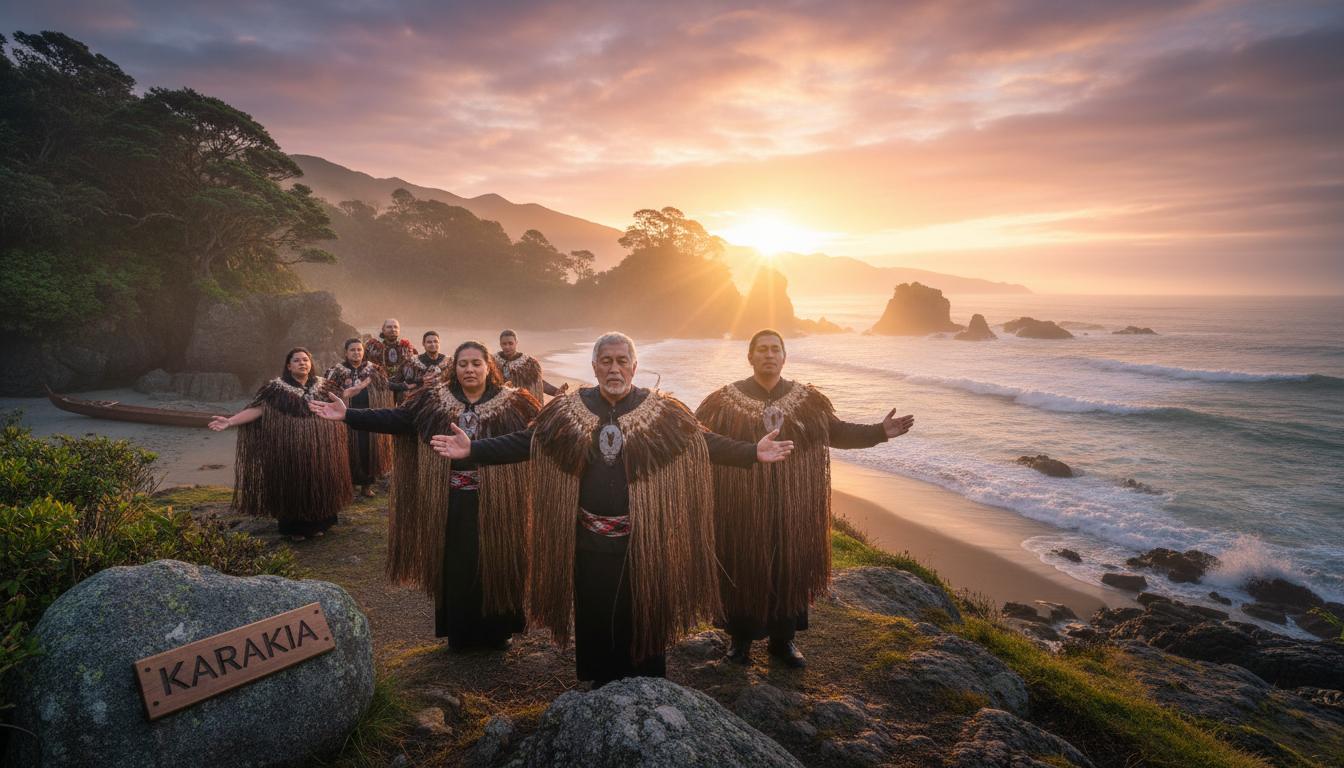
If you live in Aotearoa New Zealand, you’ve likely heard a karakia to open a hui, bless kai, or close a busy day. It’s familiar, grounding, and deeply Māori. This guide explains what karakia is, how it works, where it fits, and how to use it respectfully at home, at work, and on the marae.
What is
Karakia are Māori prayers, incantations, or ritual chants. They set intention, call for guidance or protection, and mark transitions—from tapu (restricted, sacred) to noa (settled, everyday), from arrival to departure, from uncertainty to clarity.
While people often translate karakia as “prayer,” it’s broader than a religious label. Karakia can be spiritual, cultural, and practical at once. They can acknowledge atua (spiritual guardians), ancestors, the natural world, or simply give thanks. In modern life, karakia appear in schools, workplaces, sports teams, whānau gatherings, and civic events, not only on marae.
Karakia vary by iwi and hapū. Some texts are widely shared; others are restricted to certain contexts or lines of descent. Local tikanga (customs) and kawa (protocols) guide what is appropriate. When in doubt, seek advice from mana whenua, kaumātua, or cultural advisers.
How it works
At its heart, karakia brings people into the same space—mentally, emotionally, and spiritually. The words, rhythm, breath, and intent link a group together and tune the room. That’s why a short karakia can shift a meeting from scattered chatter to focused kōrero in under a minute.
Common features include:
- Intention: naming purpose—opening, blessing, protection, closure
- Address: calling on atua, tūpuna (ancestors), or the environment
- Transitions: moving from tapu to noa, or into and out of a task
- Structure: an opening, body, and a closing line or word (e.g., Āmine, Amine, Amene)
- Delivery: often one person leads; others may respond “Āmine” or join in together
On the marae, who speaks and when follows kawa. In the office or classroom, the flow is simpler: someone sets the scene, offers a short karakia, and the group carries on. Many groups pair a karakia with a waiata to reinforce unity and warmth.
Types / examples
Different karakia suit different moments. Below are common types you’ll encounter. Names given are general; specific texts vary.
Karakia timatanga (opening)
Opens hui, classrooms, workshops, and ceremonies. It focuses minds, clears the way, and invites guidance. A well-known example many groups use is “Whakataka te hau,” which prepares the environment and people for the task ahead.
Karakia whakamutunga (closing)
Closes a session, thanks participants, and releases the group back to everyday life. It can include gratitude, a call for safe travels, and a final settling into noa.
Karakia mō te kai (grace)
Blesses food, thanks those who provided it, and acknowledges the energy it gives. A simple, widely used form begins with “E te Atua” or addresses the source of the food and the hands that prepared it.
Karakia for safety and travel
Asks for protection on journeys, at sea, in the bush, or on work sites. In contemporary settings, you’ll hear safety karakia before fieldwork, construction, or large events.
Karakia whakanoa (to make noa)
Used to lift tapu or clear a space after a significant event. Often led by someone with appropriate authority and knowledge. In general workplaces, stick to simple opening or closing karakia unless guided locally.
Karakia for wellbeing
Offered for strength, healing, or comfort. These can be sensitive. Use only with guidance, especially in clinical or crisis settings.
Publicly known examples
Some texts are commonly shared across the motu, such as “Whakataka te hau” (opening), “Unuhia, unuhia” (clearing), and short kai blessings. If you’re unsure whether a text is appropriate for your context, ask locally or use a simple, widely accepted option.
Comparison of common contexts
| Context | Purpose | Typical Length | Who Leads | Followed By |
|---|---|---|---|---|
| Opening a hui/class | Focus, guidance, prepare space | 20–60 seconds | Host, facilitator, or designated person | Introductions, agenda |
| Closing a hui | Thanks, safe release to noa | 15–45 seconds | Same person who opened, or chair | Waiata, notices, karawhiua (wrap-up) |
| Blessing kai | Gratitude, acknowledge sustenance | 10–20 seconds | Any willing person | Meal begins |
| Travel/safety | Protection, clarity, care | 15–45 seconds | Team lead, kaimahi, or kaumātua | Briefing, task start |
Pros and cons
Benefits of using karakia
- Respects Te Ao Māori and local tikanga
- Creates focus and calm at the start or end of activities
- Builds team unity and psychological safety
- Honours relationships with people, place, and purpose
- Supports wellbeing by offering a moment of reflection
- Signals genuine commitment to Te Tiriti and a bicultural workplace or school
Considerations and pitfalls
- Tokenism: avoid tacking on a karakia without meaning or context
- Mispronunciation: practice is key; keep it simple until confident
- Context: some karakia are restricted; don’t use sacred texts casually
- Inclusion: be mindful of mixed beliefs; invite, don’t compel participation
- Consistency: align with local kawa; don’t mix protocols across settings
How to use or choose
Here’s a practical way to bring karakia into daily life with respect and confidence.
Step-by-step: lead a short karakia at work or school
- Seek guidance: ask mana whenua, a Māori colleague, or a cultural adviser what’s appropriate for your setting.
- Choose a simple text: pick a widely used opening or closing karakia suited to your purpose. Start small.
- Learn the meaning: understand the intent line by line so you can explain it in plain English.
- Practice pronunciation: say it aloud slowly; use macrons; record yourself; correct errors early.
- Set the scene: tell the group what you’re doing—“We’ll start with a short karakia to focus us.”
- Invite participation: people can listen, stand, or join if they know it; no pressure.
- Deliver steadily: clear pace, warm tone, confident finish. A short pause lets it land.
- Close the loop: translate or summarise in English if helpful; move into the agenda or meal.
- Reflect and improve: ask for feedback from Māori colleagues or mentors; adjust as needed.
How to choose the right karakia
- Match the purpose: opening (timatanga), closing (whakamutunga), kai, travel, safety
- Follow local tikanga: check with mana whenua for marae or regional preferences
- Consider audience: pick a length and reo level that suits your group
- Provide access: share the words on screen or handouts; include macrons and a translation
- Keep integrity: use the full text as taught; avoid editing meaning without guidance
- Offer alternatives: if someone opts out, allow a quiet pause; participation should be voluntary
Traditional and contemporary styles
Both traditional and contemporary karakia have a place. The key is context and respect.
| Aspect | Traditional Karakia | Contemporary Karakia |
|---|---|---|
| Language | Archaic te reo Māori, metaphor-rich, genealogical references | Modern te reo, often simpler wording |
| References | Atua, cosmology, tapu/noa processes | Gratitude, values, collective intent; may name atua or use secular language |
| Setting | Marae, ceremonies, specialist contexts | Workplaces, schools, teams, daily routines |
| Leadership | Often kaumātua or someone with specific authority | Any prepared person, with local guidance |
| Access | Some texts restricted or taught in context | Widely shared resources, printed cards, posters |
Pronunciation tips
- Macrons (ā, ē, ī, ō, ū) lengthen vowels—don’t skip them
- R is lightly rolled; WH is usually “f” in most dialects
- Stress the second-to-last syllable in most words (ka-ra-KI-a)
- Slow is smooth; smooth becomes confident
FAQ
What does karakia mean?
Karakia are Māori prayers or incantations used to set intention, seek guidance or protection, and mark transitions such as opening and closing gatherings or blessing food.
Do I have to be Māori to lead a karakia?
No, not necessarily. Many workplaces and schools encourage anyone to lead a simple karakia with respect. For formal or sacred contexts, leadership usually sits with those who hold the role under local tikanga.
Is karakia religious?
It can be. Some karakia directly address atua, while others are more about gratitude, focus, or unity. Many secular settings still use karakia to bring people together respectfully.
Can we say karakia in English?
Yes. Some groups use English versions to include everyone while learning te reo Māori. If you use a Māori text, provide a translation so people understand its meaning.
When is it not appropriate to use karakia?
Don’t use karakia as decoration or filler. Avoid sacred or restricted texts outside their proper context. If you’re unsure, choose a simple opening or closing karakia or ask for guidance.
How long should a karakia be?
Short works well: 15–60 seconds is common in daily settings. Ceremonial contexts may be longer and are guided by local kawa.
What’s the difference between karakia and waiata?
Karakia are spoken or chanted prayers/incantations. Waiata are songs. They often sit together: a karakia may open a space, and a waiata follows to support and uplift.
Is it okay to share a karakia on slides or handouts?
For widely used texts, yes. Include macrons and a translation. If a karakia was gifted to your group or is tied to a specific iwi, ask permission before publishing or distributing it.
Who should I ask about local practice?
Contact mana whenua, a local marae, kaumātua, or your organisation’s Māori advisory group. They can confirm which karakia fit your context and how to deliver them well.
What if people in the group have different beliefs?
Frame karakia as an invitation, not a requirement. Offer a moment of reflection where people can engage in their own way, or provide an English alternative alongside te reo Māori.
Key takeaways
- Karakia set intention and create safe, focused spaces across Aotearoa New Zealand
- Choose the right karakia for the moment: opening, closing, kai, travel, or safety
- Follow local tikanga, keep it simple, and practise pronunciation
- Invite participation and explain meaning to include everyone
Used with care and heart, karakia turns routine moments into shared purpose. That’s its quiet power—bringing people together, then sending them on their way, a little more aligned than before.